Summer is here and we are so very much looking forward to spending more time at our tiny cabin this summer with our two galgos Amity and Hestia. These two senior ladies (11 years old!) are Spanish Greyhounds from Spain and love our little cabin in the woods as much as we do.
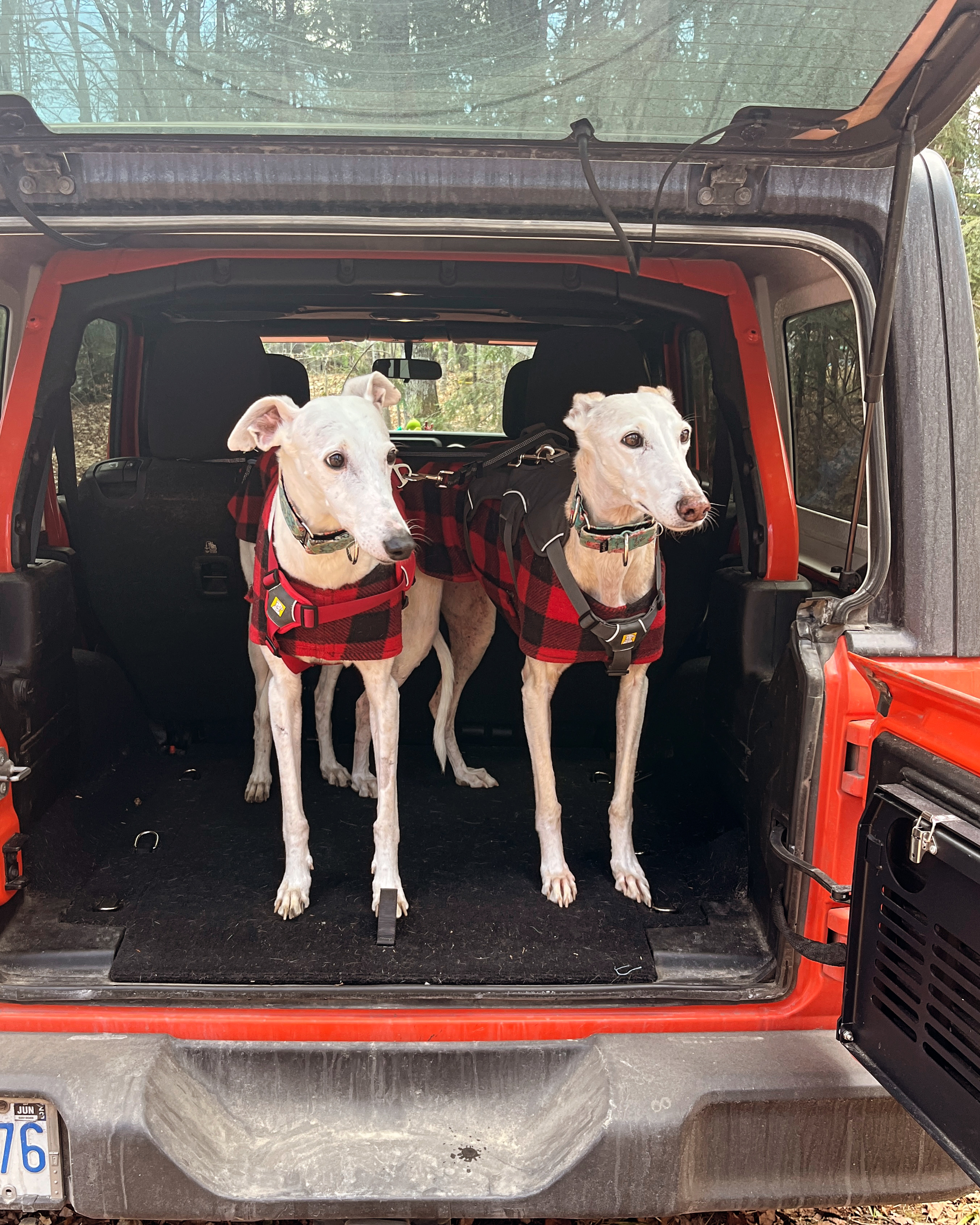
The problem? They love to run but don’t have any recall. This is very typical of sighthounds – galgos, American greyhounds, whippets, lurchers, borzois, Afghans, to name a few. They see something, their prey drive kicks in, they accelerate to top speed in a few seconds and they are GONE. They see and hear nothing but their prey. And vehicles just can’t stop in time. Also, these dogs have been bred for centuries to hunt and no animal is able to outrun them – not rabbits, squirrels, cats or even small dogs. Not only that but sighthounds are a particular type of dog. Greyhounds and galgos are even more particular.
Galgos and greyhounds are born and raised *only* with other galgos and greyhounds. So their social communication is different than other breeds. (Think of the dialects of English that are spoken in isolated communities and how difficult it is to understand that English if you aren’t familiar with the accent.) Which is why greyhound and galgo owners tend to have several of them and often only these breeds. They can be intense because they have been bred for centuries to be competitors. They can turn it on to 200% and then turn it off to absolute zero 30 seconds later and are the world’s fastest couch potatoes. They don’t generally touch each other when playing. In fact, they are quite offended by the more physical play of other breeds. Their idea of tug-o-war is more like a stand-off. They enjoy running beside each other. And snuggling with their humans. There’s really nothing in between.

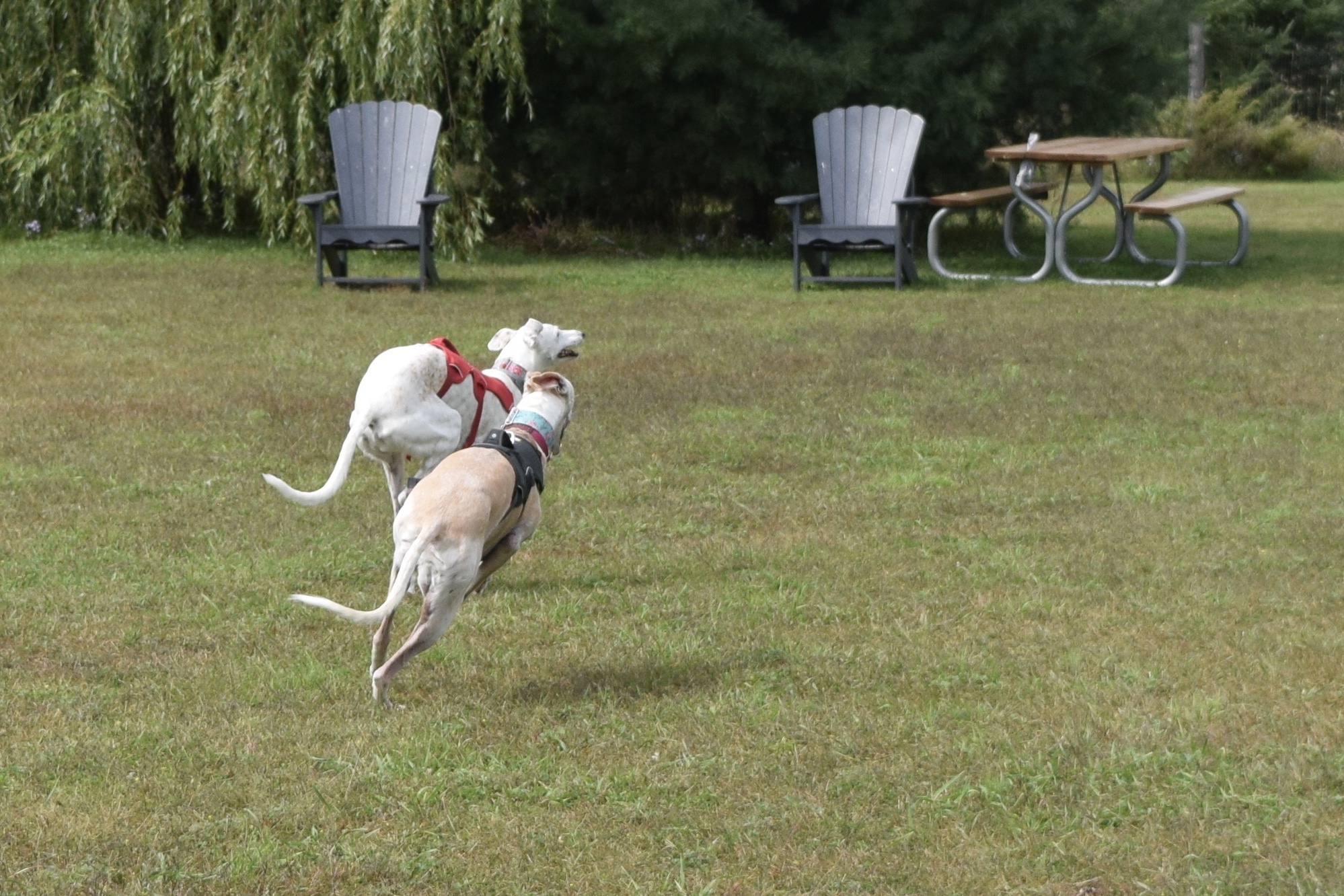
Needless to say, because of this, dog parks aren’t always successful with our dogs but we are very lucky in our area to have several private and reservable dog parks that are fully fenced. Country Canines Play Park, a large, wide-open spaces perfect for the greyound/galgo sprint and Finnobi Forest, a forested area with trails, perfect for more exploratory play. If you are anywhere near these play parks, then you really should reserve a time to check them out. They are AMAZING!
While visiting Finnobi Forest, it reminded me of the land we have at the cabin. Our one-acre pie-piece is mostly wooded area that we aren’t using. What if we put up a fence and let our two senior ladies have some off-leash time? An idea was born.
Disclaimer: The following description of the enclosure we built might not be strong enough for a dog that is reactive, skittish, adventurous, a digger or a climber. Our dogs are none of those things. They just don’t know when to stop running.
At first we were hoping to fence the entire wooded space but we came up against two obstacles – the cost and the terrain. Our land is not flat and the low part is really wet with lots of deadfall. A quick measurement of the perimeter had us looking at close to $1300 for just the wire fencing. In these times of frugality, that was just too much for us.
So we compromised and planned for a smaller enclosure with a 200′ perimeter on the flattest part of our property. This section borders the laneway, the cabin, it cuts through the middle of the pie piece and luckily only has about 20′ that runs parallel to the road. “Lucky” because one of our dogs can be a loudmouth through fences. This way, those walking along the road, especially with their own dog, only have to listen to her belly-aching for a few feet.
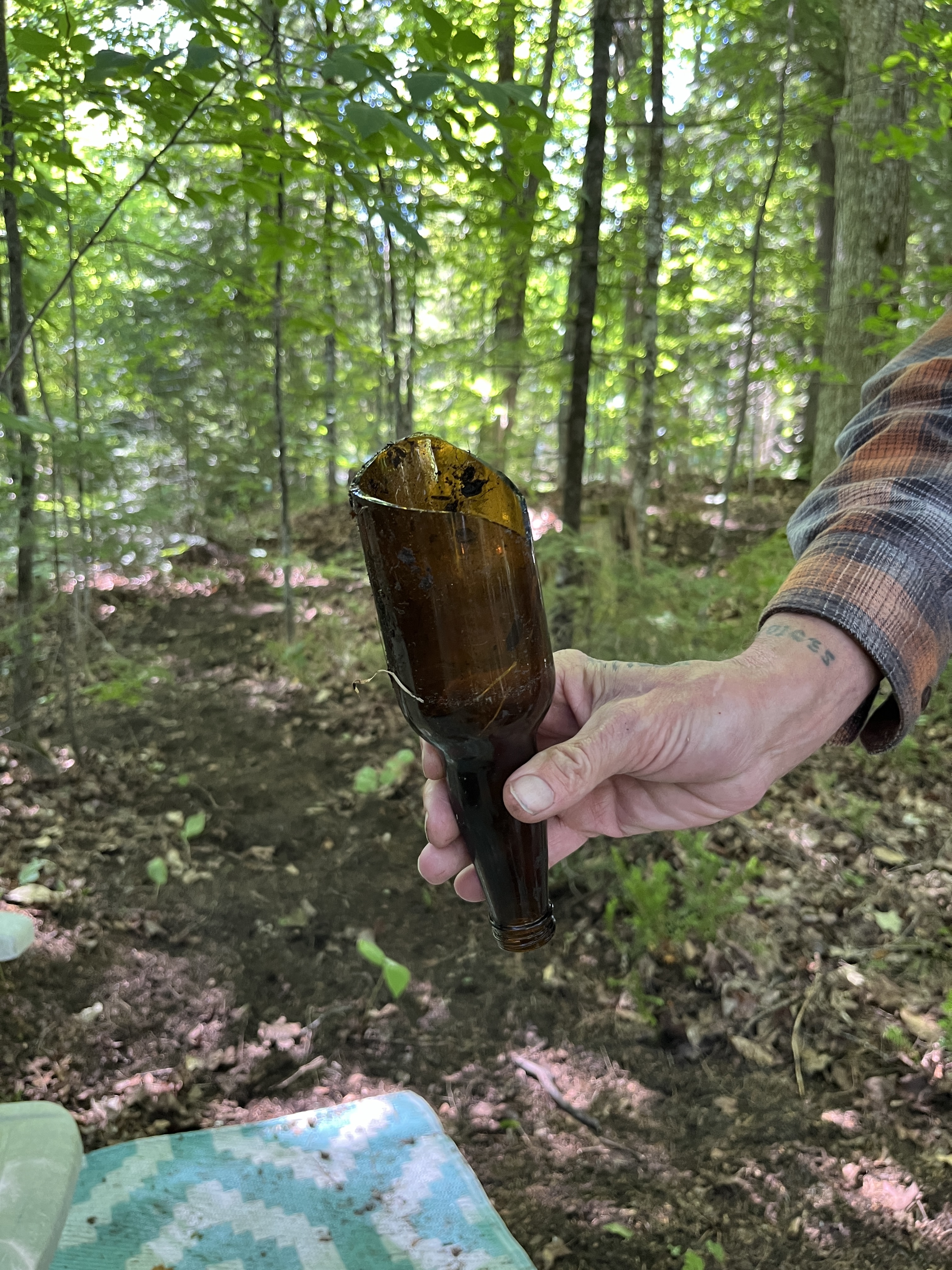
The first thing we did was walk around the property with flagging tape to map out the possible perimeter. We maximized use of the trees so it is definitely an irregular shape. This way we had a good idea of the size of the area and could easily modify it if we felt it was too small. Then, we started building paths. We meandered through the smaller trees, trying to find a natural route so we didn’t need to uproot too many saplings. It was surprisingly easy. I raked the leaves to the side to make sure there wasn’t anything dangerous hidden underneath. It’s a good thing I did because we found several pieces of dangerous debris – a broken beer bottle, a rusted can, not to mention a rodent hole (broken galgo leg for sure!) and spear-like roots which could definitely cause some damage if stepped on. I had to uproot some tiny saplings but for the most part, we made an interesting zoomie path for them, with a couple of different routes. We didn’t have the fence up at this point but having these paths already cleared certainly made it easier for us to see the perimeter and work in the area as well.
It is still big enough for them to do an early morning or late night bathroom break without getting kitted out in their harnesses and double leads (two leads – one on the harness and one on the collar – because they are incredibly strong and wily). They still need to be on lead of course to get to the enclosure since it’s not attached to the cabin but it will be easier and more comfortable for them to just run in, do their business, have some early morning/late night sniffs of the neighbouring critters than taking them on a walk around the “loop” (the road that has all the cottages on it) with the fear of other dogs (because our ex-hunter is reactive on lead), larger predators (coyotes) in the dark, or my having to be ultra-vigilant that my ex-hunter doesn’t rip my arm off with a lunge for the jackrabbit hidden in the tall grass by the side of the road. (Yes, I’ve had a pulled shoulder muscle, a bruised wrist and a twisted ankle all from her 60 mph lunge after prey.) Not only that, with these recurring heat waves, it allows the dogs to get some exercise without wearing their harnesses and without getting too hot and too far away from the cabin on the walk.


We had a few challenges we needed to figure out before we actually started putting up the wire fencing. First of all, the height of the fence. Galgos generally need a 6″ fence because they are expert jumpers – not climbers, JUMPERS. Our two fuzzy buddies are quite senior and a bit arthritic at this point. Not to mention they never travel too far away from us, even at the off-leash parks, so part of me thought we’d be fine with a lower fence. But I have seen them jump over an entire set of patio furniture to chase a squirrel in the yard or jump up 6 steps AND the dog sitting at the top of them from a standstill. I have seen only slightly younger galgos jump over a 5′ fence as if it were a baby gate. Ultimately, one of our girls was a successful competitive off-leash hunter for 8 years and I don’t want her to see something on the other side of a lower fence and think, “Yeah, I can jump this!” This is the biggest difference between greyhounds and galgos. Galgos are really clever and really motivated. They are opportunists and explorers. We have 8″ fences at home and when I take them to the play parks that have five foot fences, I have to keep an eye on the retired hunter. Because even at the age of 11, she keeps an eye on the field beyond the fence, looking for quarry. So we opted for the 6′ fence that is recommended for this breed. While these two might not challenge it, we will most likely have another galgo in the future and he/she might.
Why go through all this work for two 11 year old dogs? Because they deserve it. They survived 7 or 8 years of abuse, being treated like tools for a sport instead of as cared-for pets. They deserve to have anything that makes them comfortable. *For more info on this amazing breed and their plight in Spain, you can check out a number of Spanish rescues and international groups that bring these amazing dogs to Canada and other countries. We’ve adopted three Galgos and they will absolutely change your life.*
The other question was what gauge would be best. We needed to balance durability with flexibility. A friend who recently adopted a four-year-old male Galgo opted for 12-guage and now that she has had him almost a year, she said she wouldn’t go any less because his energy level and prey drive are quite high. Since our two have never challenged a fence, I figured we’d be safe with a slightly lighter guage, one that would make the fence slightly more flexible over the uneven parts of the land. In the end, we opted for four rolls of 50′ 14-guage wire fencing with a 2″x 4″ grid from Home Depot.
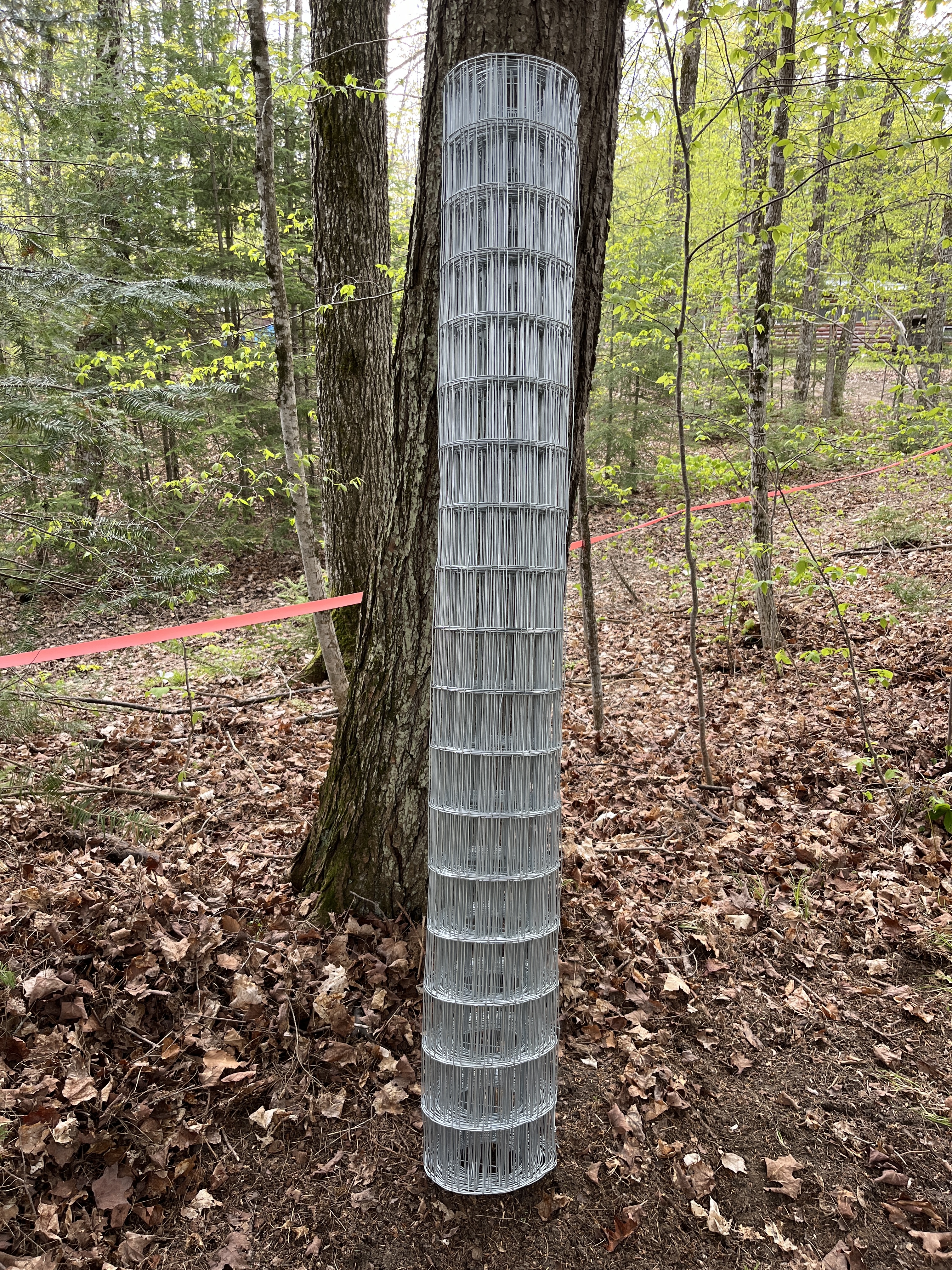
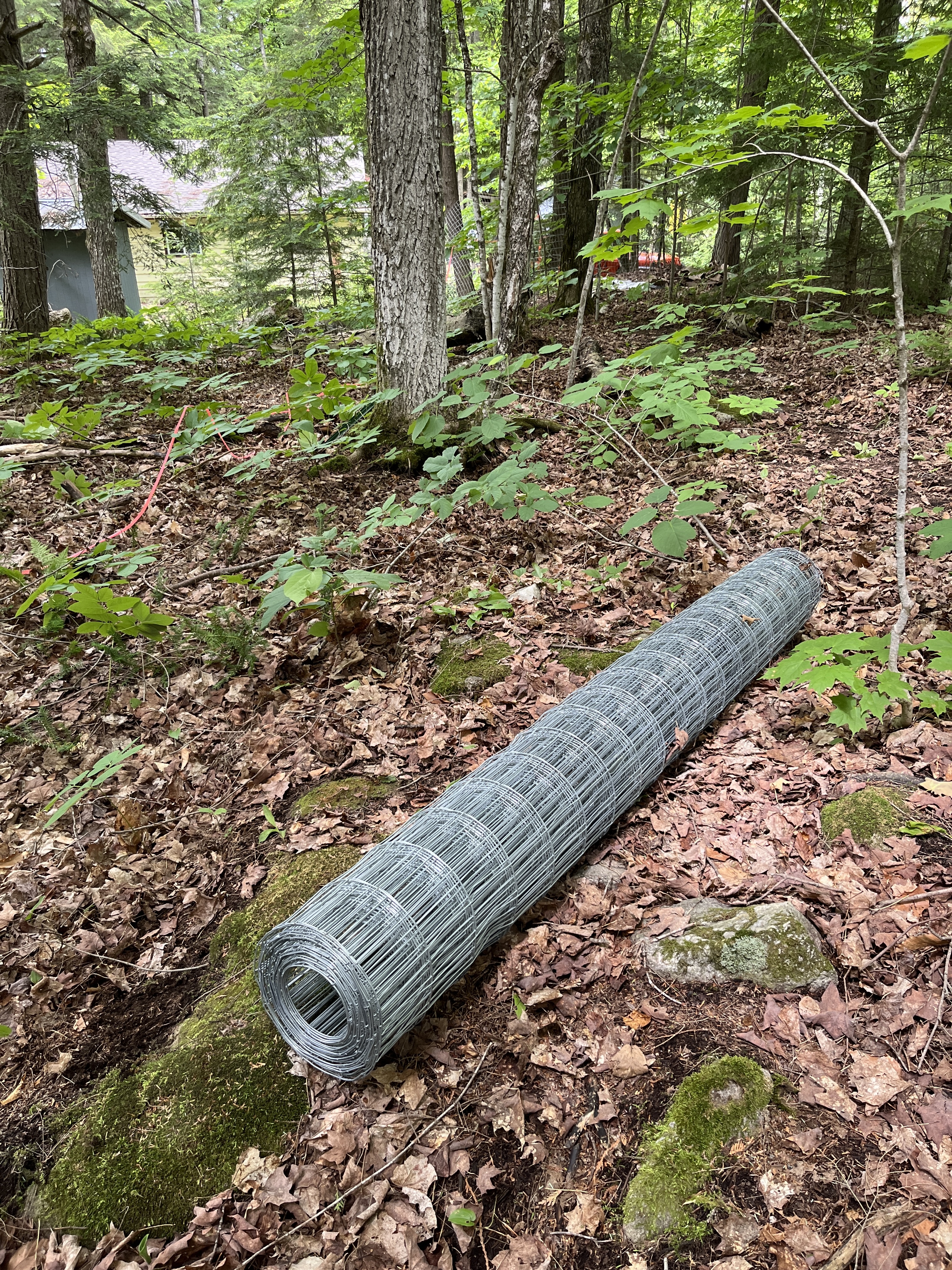
The plan was simply to use the trees as the fence posts where we could and then fill in the larger spaces with T-bars. We wanted to do this because we wanted the option of taking the fence down and returning this fenced space to a completely natural space if we wanted to in the future. Doing it this way, we only needed to buy 6 T-bars. We found the 14-gauge fencing to be light enough for me to lift (awkwardly) on my own, fairly easy to unroll and sturdy enough to withstand the dogs, should they decide to put paws on it. It was also easy enough to bend the ends together from one roll to the next. To attach them to the trees we first wrapped bungee cords around the fencing and trees. These were just to hold the fencing in place while we worked out the perimeter. We used zap straps to attach them to the T-bars. Once the perimeter was in place, we tied forest green paracord around the fencing and trees and T-bars at the top, middle and bottom to ensure stability (when snow piles up) yet flexibility (when the ground heaves) over the winter and removed the unsightly, brightly-coloured bungees.


In a few parts, the fence didn’t exactly touch the ground. If we were trying to contain a stronger, younger, more energetic or motivated dog, we would pin the fencing to ground with metal u-shaped stakes. But we are pretty sure we can get away with piling leaves and deadfall to fill up the gaps. Our two dogs don’t really go looking for escape routes.
This fencing is actually very subtle in the woods. We worried about the aesthetic of a fence in the middle of our wild, wooded area but in the end, the bungee cords around the trees were much more noticeable than the fencing. In fact, it’s hard to get a good photo of the fencing because it really fades into the environment. After we switched to the green paracord, the whole structure blended into the environment and the fence became almost an afterthought when you looked in the woods. Within the thirty seconds of running free within the enclosure, our klutzy galga ran right into it! It held up against the force of a half-speed galgo so that’s promising! But just to be safe, we added blue “flags” to the fence around the perimeter at the dogs’ eye level so that they could learn where the boundaries are to prevent this kind of accident happening again. And of course, just for a whimsical touch, we added some garden gnomes to the tree stumps and deadfall.

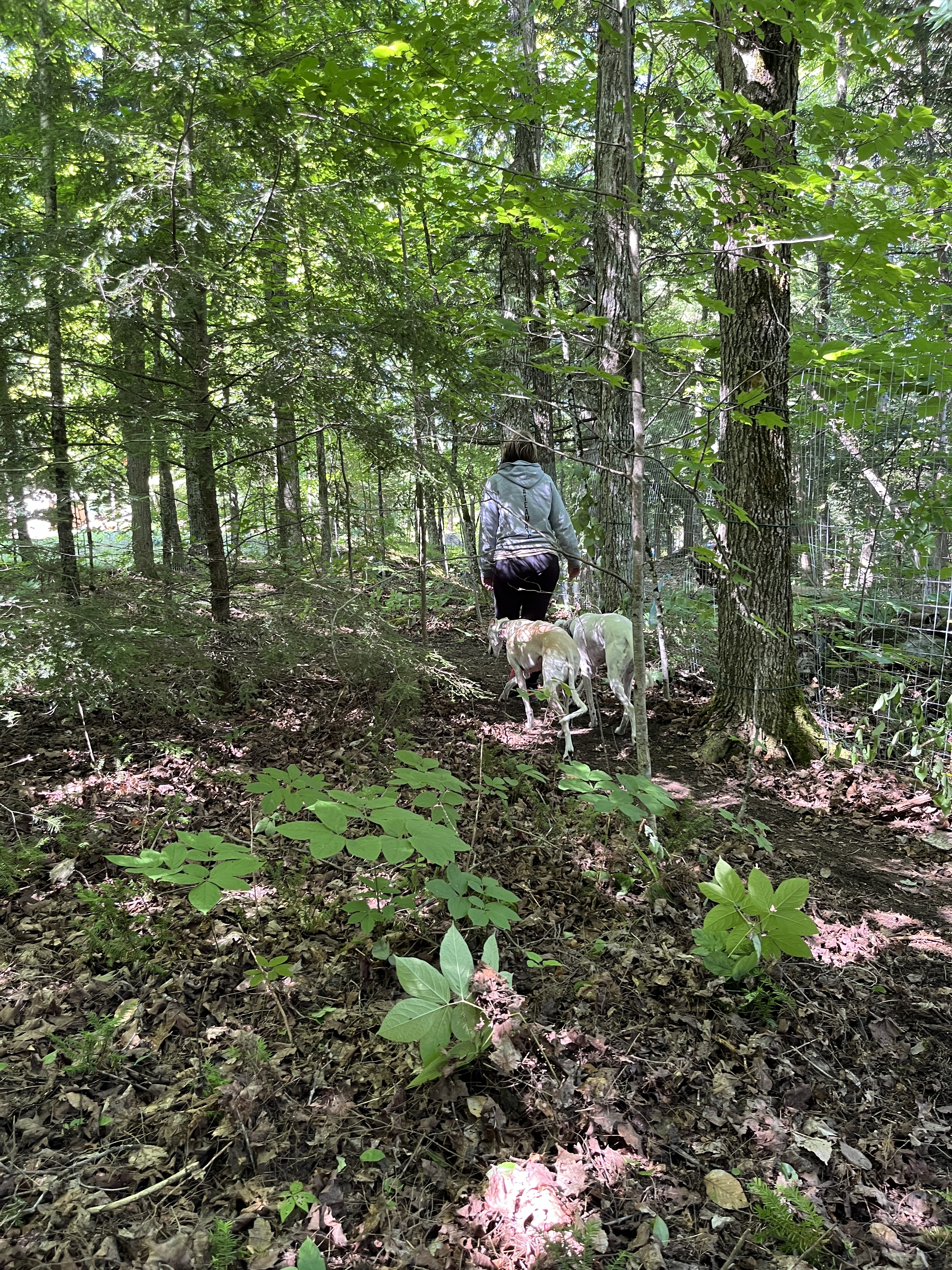
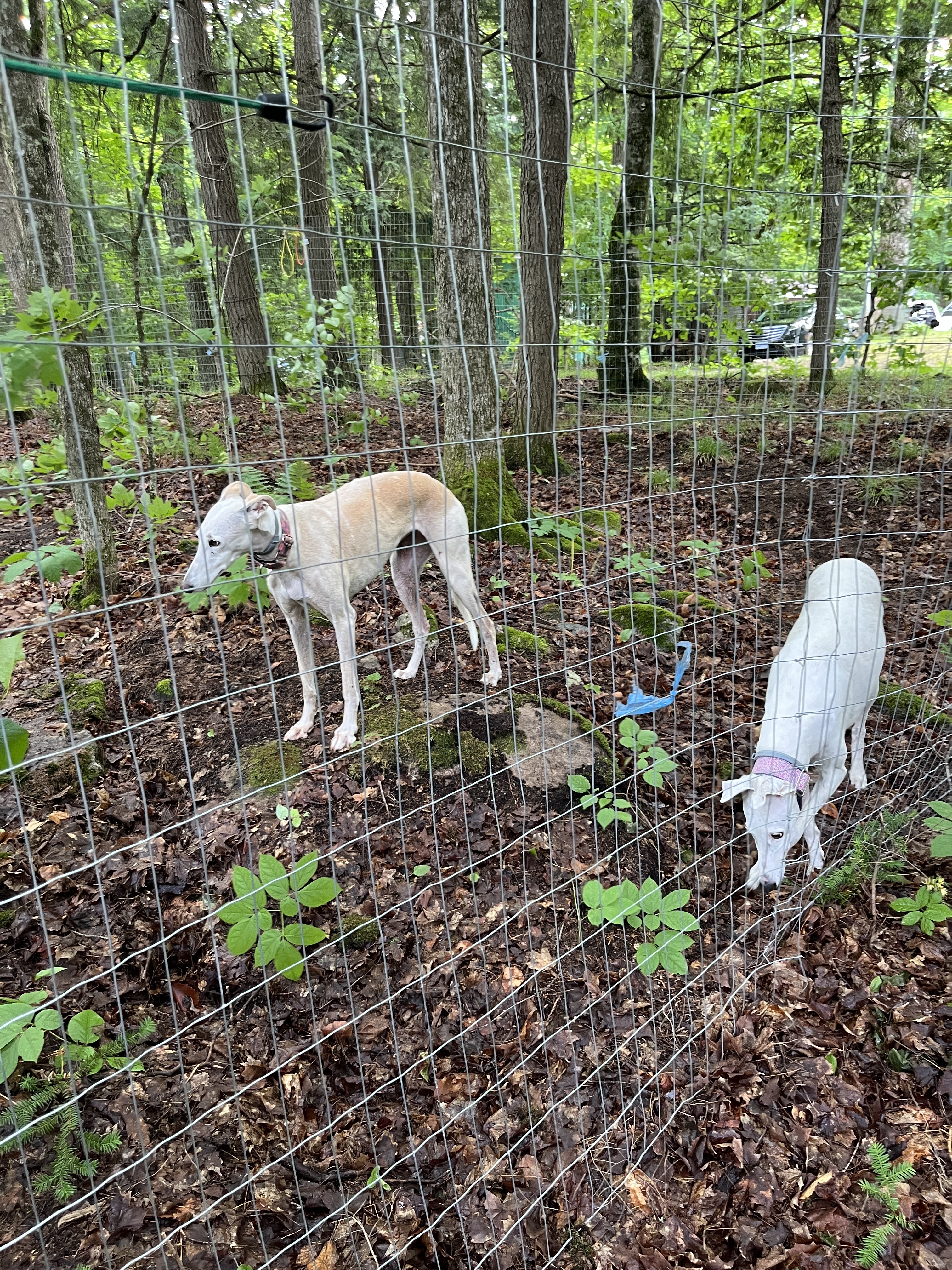

For the gate, we had to improvise a bit. The land is very rocky and we simply couldn’t dig deep enough to put 4×4 posts. So we dug small holes for 4′ 4×4’s, cemented around the bottom and then just wrapped the fence around them for stability. We simply unroll the wire fence and clip it shut at the top and bottom.
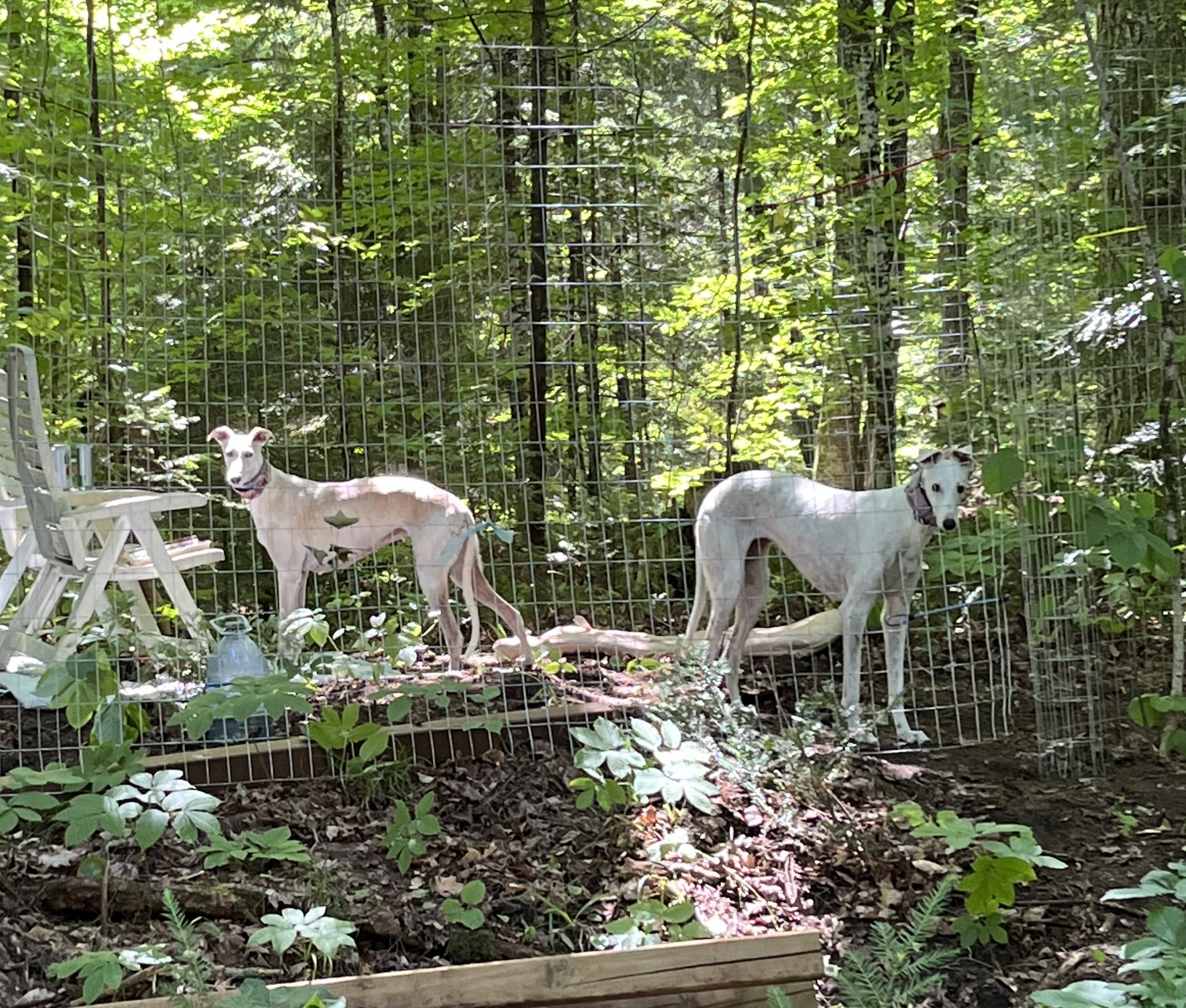
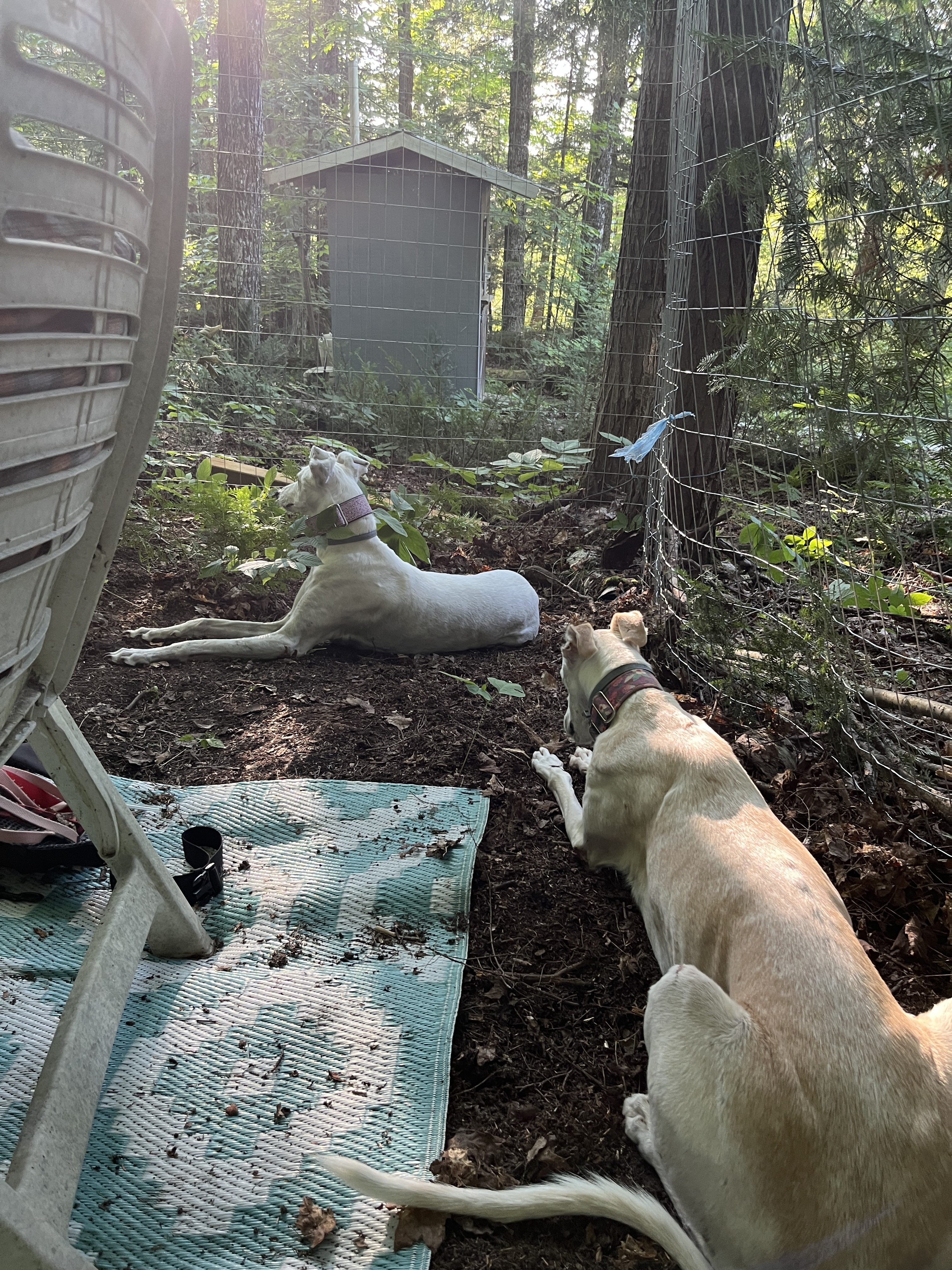
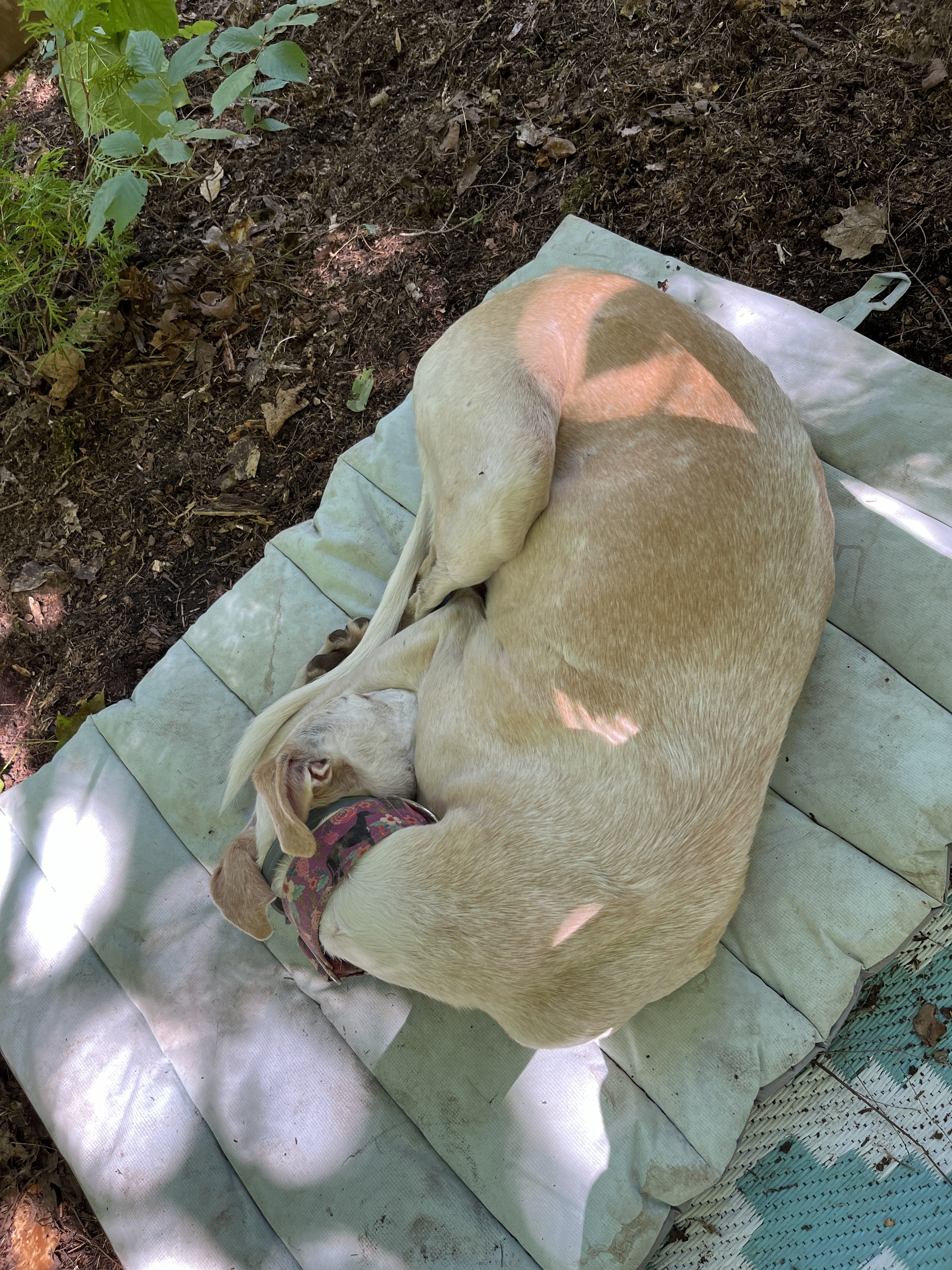

Finally, we brought in an outdoor mat, two chairs, a bistro table, and two cushions for the dogs to lie on, even though they have demonstrated that they are fine digging a hole in the dirt to lie in as well. Our dogs are not especially active. But being able to sit with them outside and have them free to explore at will is a wonderful break for them and us. It feels far more natural and we can also ensure their safety at the same time. If you’d like to see them running around having a good time, you can check out this link on their Instagram page.
And because we are people who love to give things and places names, we went through all the magical and mystical forest names that we could think of and settled on the playful name of Endor, the Ewok planet for this lovely little piece of off-leash heaven. If only I had Ewok action figures to place around Endor…
 Tiny Cabin, Big Dreams